over serial Hines in NEURON across the paper-reported configurations
PAPER-REPORTED PERFORMANCE
Benchmarks, with the original evidence.
Explore equation solving, GPU memory optimization, full-spine simulation, and detailed-neuron learning through high-resolution figures rendered directly from the published paper.
memory-boosted DHS over the CoreNEURON GPU method in the reported comparison
over CoreNEURON GPU / serial NEURON CPU in the published workflow
training speedup over the reported CPU-based platform
01FIGURE 3
GPU MEMORY OPTIMIZATION
Move the schedule closer to the data.
DHS exposes parallel work; memory boosting makes that work cheaper to feed. The paper reorganizes compartments with the same execution order, reuses registers for intermediate results, and reduces global-memory transactions.
REPORTED GAIN1.6–2×memory boosting across the Figure 3 spine-model sweep
MEASUREMENT500–3,000layer 5 pyramidal cells with spines
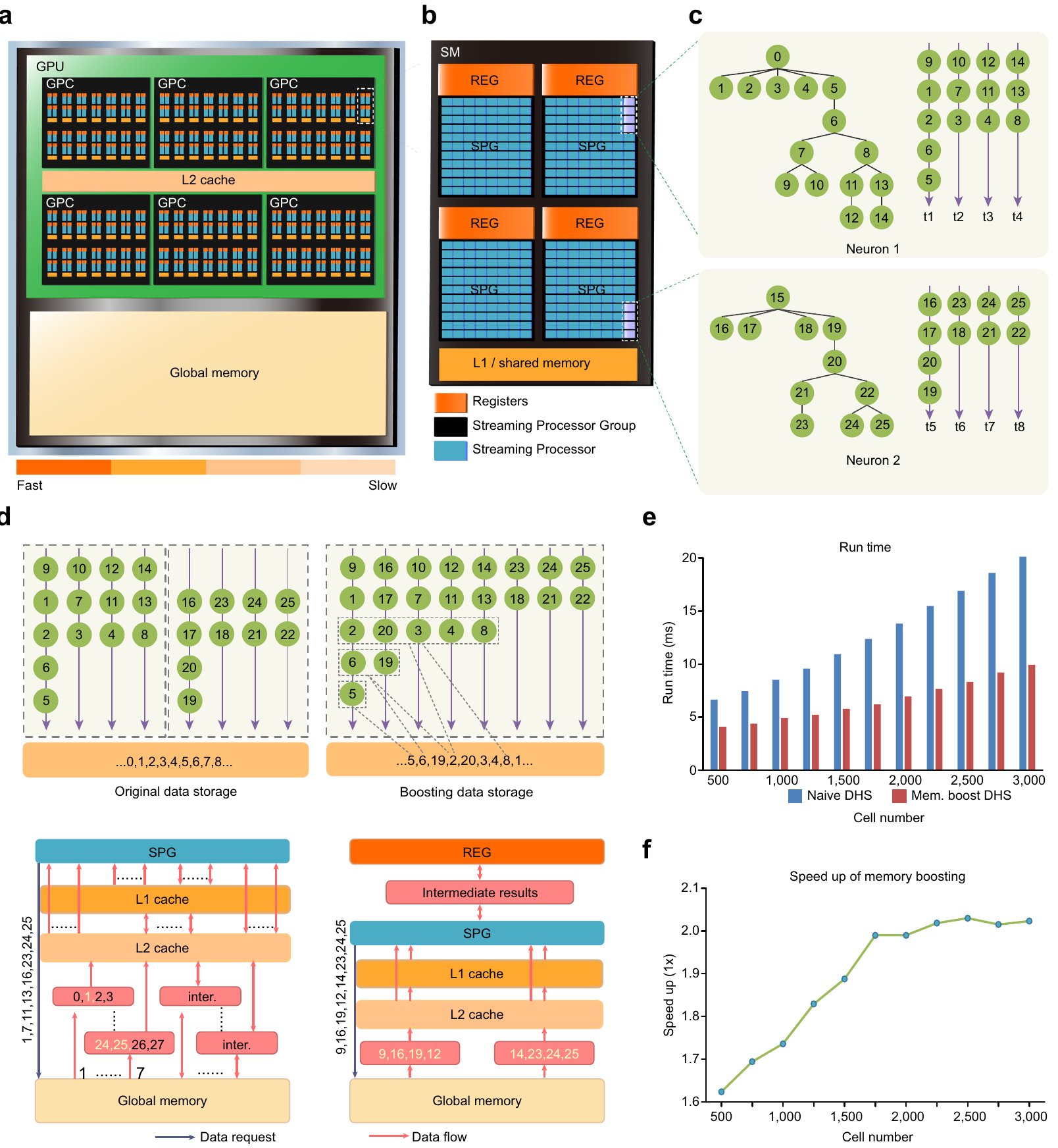
02FIGURE 4
CELL-TYPE-SPECIFIC SCHEDULING
Adapt the partition to each morphology.
A fixed split does not fit every dendritic tree. DHS assigns branches to four or sixteen threads according to topology, producing a cell-type-specific partition while preserving the equation dependencies.
MODEL RANGE6 cell typesSPN, Purkinje, CA1, CA3b, mitral, and pyramidal
NETWORK SCALE500–3,000cells in the reported one-second simulation
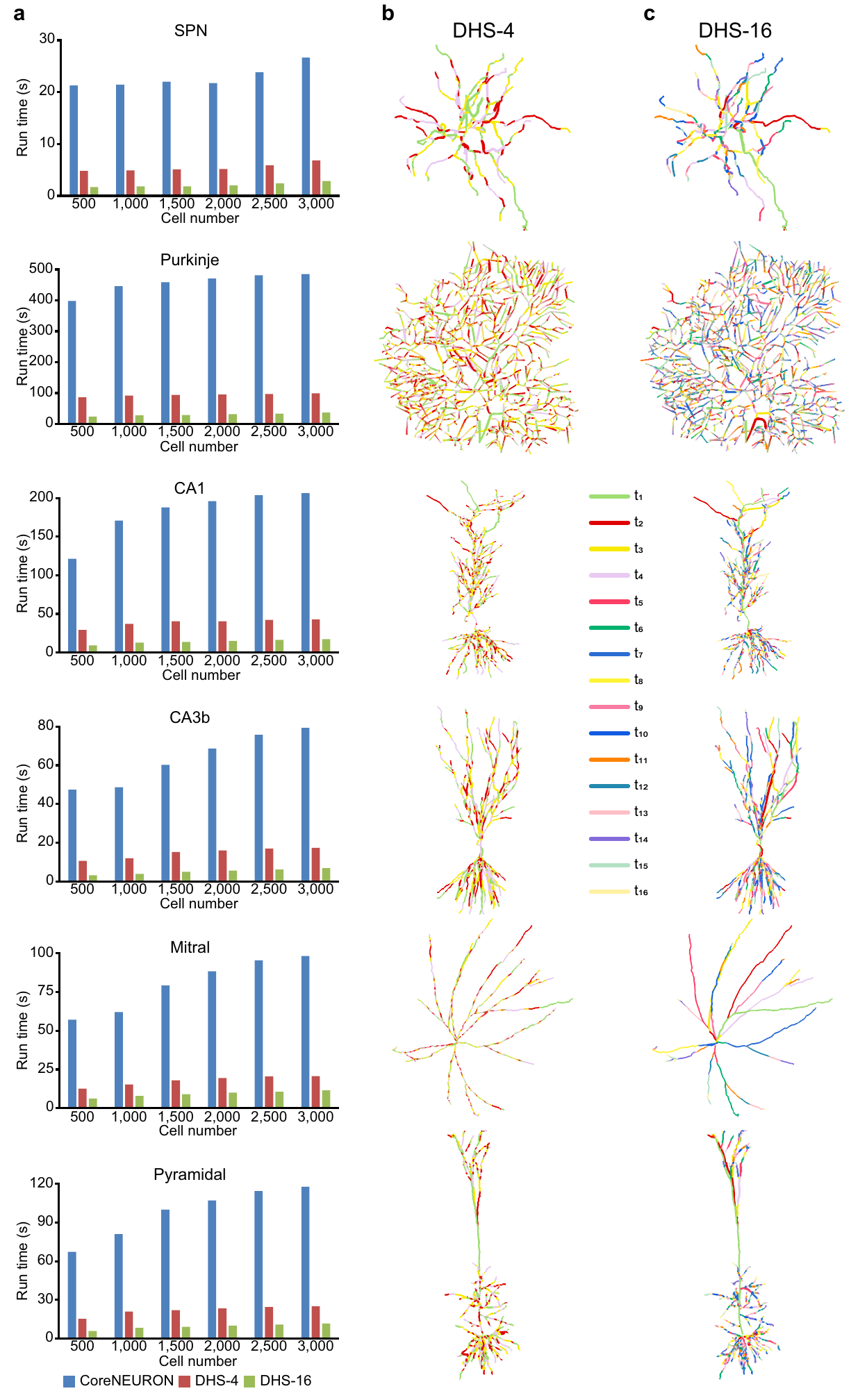
03FIGURE 5
FULL-SPINE BIOPHYSICS
Make spine-level modeling practical.
The full-spine workflow explicitly attaches every reconstructed spine instead of representing most spines with a dendritic area factor. It then compares clustered and distributed activation through voltage traces and spike probability.
MODEL DETAIL24,994explicit spines more than 60 μm from the soma
REPORTED SPEEDUP8× / 100×over CoreNEURON GPU / serial NEURON CPU
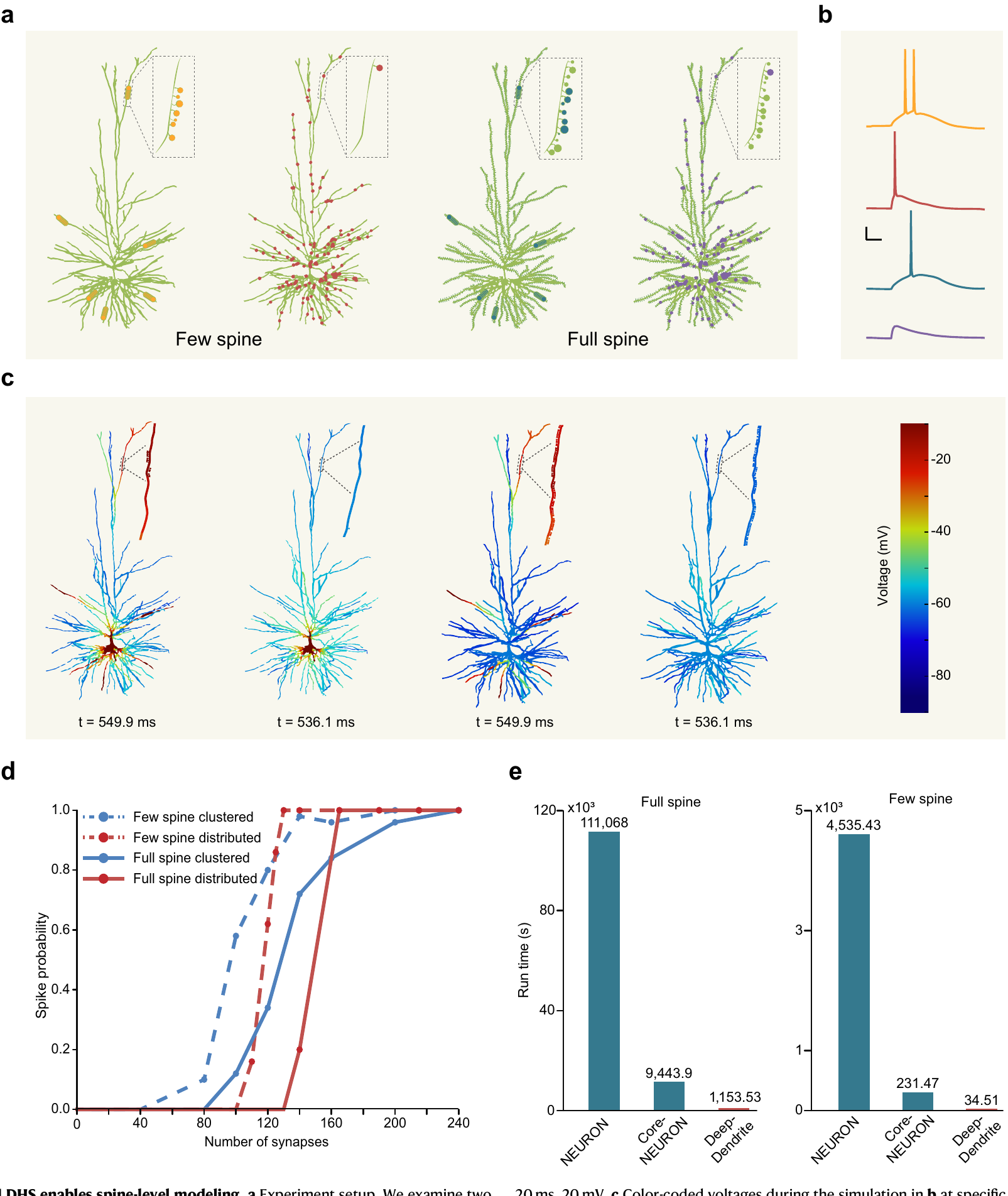
04FIGURE 6
DETAILED-NEURON LEARNING
Train networks built from human pyramidal cells.
The Human Pyramidal Cell Network encodes images as spike trains, uses detailed neurons in the hidden layer, and updates weights from teaching signals. The paper evaluates classification and transfer-adversarial robustness on MNIST and Fashion-MNIST.
NETWORK784 → 64 → 10three-layer HPC-Net with mini-batch size 16
REPORTED GAIN~25×training versus 40-process NEURON + Python on CPU
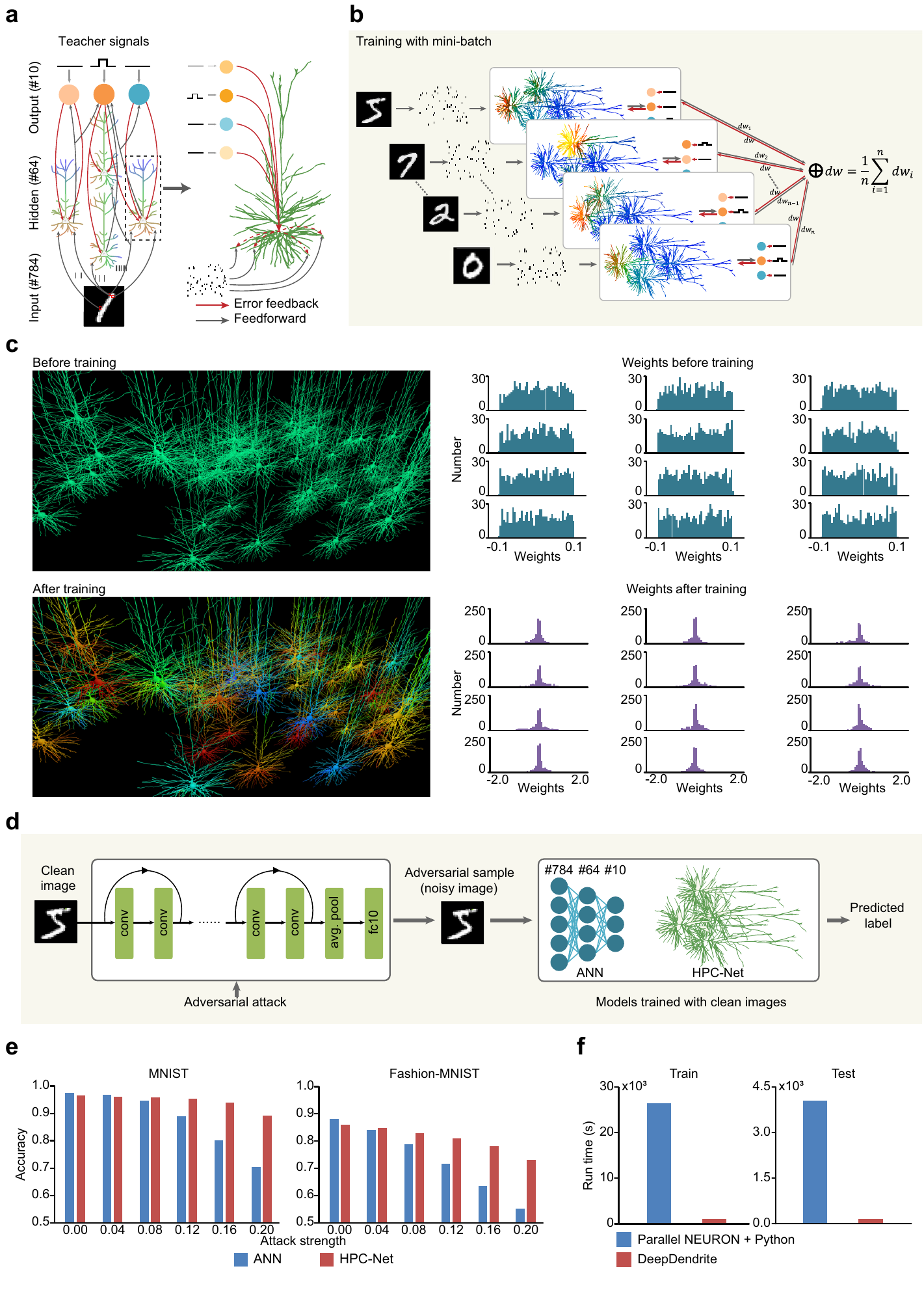
Scope of the reported results
The reported values apply to the models, hardware, compiler versions, thread allocations, and measurement boundaries described in the paper and repository. They are evidence for those experiments, not a universal guarantee for every NEURON model.